


Can NMC Pouch Cells Be Connected in Series?
I'm a supplier of NMC (Nickel Manganese Cobalt) pouch cells, and one of the most frequently asked questions I encounter is whether NMC pouch cells can be connected in series. Today, I'll delve into this topic, exploring the technical aspects, advantages, challenges, and safety considerations associated with connecting NMC pouch cells in series.
Understanding NMC Pouch Cells
Before we discuss series connections, let's briefly understand what NMC pouch cells are. NMC pouch cells are a type of lithium - ion battery that uses a cathode made of nickel, manganese, and cobalt. They are often favored for their high energy density, good cycling performance, and relatively low cost compared to some other lithium - ion chemistries. The pouch design provides flexibility in terms of shape and size, making them suitable for a wide range of applications, from portable electronics to electric vehicles.
You can find more details about our 3.7 V Pouch Cell on our website.
The Basics of Series Connections
In a series connection, the positive terminal of one battery cell is connected to the negative terminal of the next cell. When batteries are connected in series, the voltages of the individual cells add up, while the capacity (measured in ampere - hours, Ah) remains the same. For example, if you connect two 3.7V NMC pouch cells in series, the total voltage of the battery pack will be 7.4V, but the capacity will be the same as that of a single cell.
Mathematically, for (n) cells connected in series with individual voltages (V_1, V_2,\cdots,V_n) and capacity (C) (assuming all cells have the same capacity):
[V_{total}=\sum_{i = 1}^{n}V_i]
[C_{total}=C]
Advantages of Connecting NMC Pouch Cells in Series
-
Higher Voltage: The most obvious advantage is the ability to achieve a higher voltage. Many applications, such as electric vehicles and high - power portable devices, require higher voltages to operate efficiently. By connecting NMC pouch cells in series, we can increase the voltage output of the battery pack to meet these requirements.
-
Compact Design: Since the capacity remains the same while the voltage increases, we can potentially achieve the desired voltage and capacity with a more compact battery pack compared to using a single large - voltage cell. This is especially important in applications where space is limited.
-
Cost - Efficiency: Instead of developing a single high - voltage cell, which can be technically challenging and expensive, connecting multiple lower - voltage cells in series is often a more cost - effective solution.
Challenges and Considerations
- Cell Balancing: One of the biggest challenges when connecting cells in series is cell balancing. In an ideal world, all cells would have the same voltage, capacity, and internal resistance. However, in reality, there are always slight variations between cells. Over time, these differences can cause some cells to become overcharged or undercharged, which can reduce the overall performance and lifespan of the battery pack.
To address this issue, a battery management system (BMS) is usually required. The BMS monitors the voltage of each cell in the series and ensures that they are all charged and discharged evenly. You can find high - quality NMC pouch cells that are compatible with advanced BMS systems on our website, such as Lg Nmc Pouch Cells.
-
Safety: Connecting cells in series also increases the risk of safety issues. If one cell fails or experiences a short - circuit, it can affect the entire battery pack. Therefore, proper safety measures, such as over - voltage protection, under - voltage protection, and short - circuit protection, must be implemented.
-
Thermal Management: As the number of cells in series increases, the heat generated during charging and discharging also increases. Effective thermal management is crucial to prevent overheating, which can damage the cells and reduce their performance.
Safety Considerations
When connecting NMC pouch cells in series, safety should always be the top priority. Here are some key safety considerations:
- Use a Reliable BMS: A good BMS can protect the battery pack from over - charging, under - charging, and short - circuits. It also helps to balance the cells and extend the lifespan of the battery pack.
- Proper Installation: Ensure that the cells are properly connected and insulated to prevent short - circuits. Use high - quality wires and connectors that can handle the current and voltage requirements.
- Thermal Management: Implement a suitable thermal management system, such as heat sinks or cooling fans, to keep the temperature of the battery pack within a safe range.
Real - World Applications
There are numerous real - world applications where NMC pouch cells connected in series are used.
- Electric Vehicles (EVs): EVs require high - voltage battery packs to power the electric motor. By connecting multiple NMC pouch cells in series, manufacturers can achieve the required voltage and capacity to provide sufficient range and performance.
- Power Tools: Many power tools, such as cordless drills and saws, use battery packs made up of NMC pouch cells connected in series. The higher voltage allows for more powerful operation.
- Energy Storage Systems: In renewable energy systems, battery storage is essential to store excess energy generated by solar panels or wind turbines. Connecting NMC pouch cells in series can increase the voltage of the energy storage system, making it more compatible with the grid and other electrical components.
If you're interested in using NMC pouch cells in your application, you can check out our Lithium Ion Pouch Cell products for more information.
Conclusion
In conclusion, NMC pouch cells can indeed be connected in series. This connection method offers several advantages, such as higher voltage output, compact design, and cost - efficiency. However, it also comes with challenges, including cell balancing, safety, and thermal management. By using a reliable BMS, proper installation techniques, and effective thermal management, these challenges can be overcome.
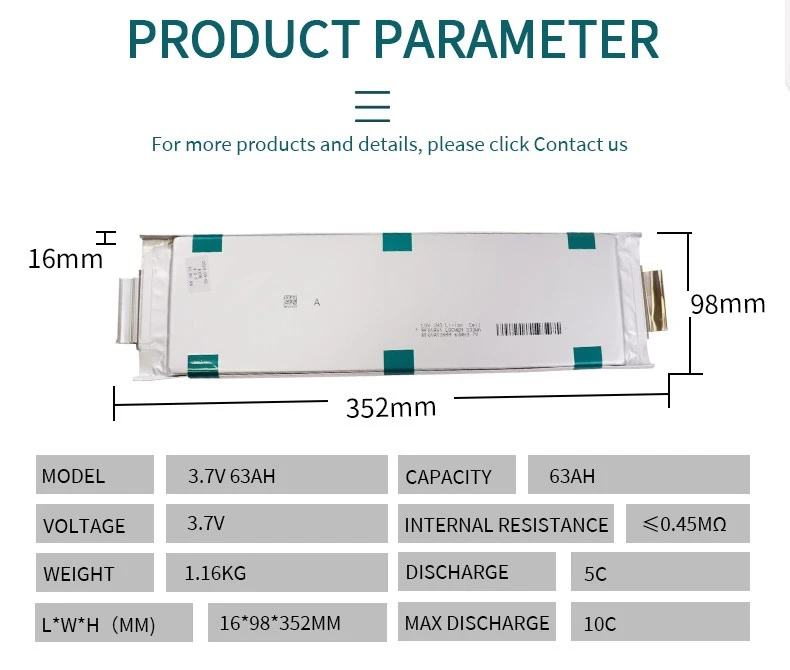

If you're considering using NMC pouch cells connected in series for your project, we're here to help. As a professional supplier, we offer a wide range of high - quality NMC pouch cells, such as the 3.7V 72Ah NMC Pouch Cell. Contact us for more details and to discuss your specific requirements. Our team of experts can provide you with technical support and guidance to ensure that you get the most suitable battery solution for your application.
References
- Linden, D., & Reddy, T. B. (2001). Handbook of batteries. McGraw - Hill.
- Goodenough, J. B., & Kim, Y. (2010). Challenges for rechargeable Li batteries. Chemistry of Materials, 22(3), 587 - 603.